
An API for developers and ERPs.
Morocco e-invoicing API, built for DGI compliance.
Tax compliance infrastructure for the modern Moroccan business. Achieve compliance in a few lines of code, without modifying your existing software.
Supported standards
- DGISupported clearance model
- Barid eSignClass 3 signing certificate
- UBL 2.1Compliant invoice schema
Trusted by
- gest360.ma
import { EFact } from '@itzenata/efact-node'

const efact = new EFact(process.env.EFACT_SECRET_KEY)

const invoice = await efact.invoices.create({
  invoiceNumber: 'INV-2026-042',
  invoiceDate: '2026-06-19',
  currency: 'MAD',
  buyerIce: '001234567890123',
  buyerName: 'Client SARL',
  lines: [
    { lineNumber: 1, description: 'Consulting services', quantity: 1, unitPrice: 12000, vatRate: 20 }
  ]
})

return Response.json({ id: invoice.id, status: invoice.status })
EFact - an e-invoicing API simple to integrate and strictly compliant with the DGI.
UBL 2.1 Schema
100%
Coverage of the Moroccan invoice schema, including XAdES-EPES signature
High Availability
99.99%
Target availability SLA, even during peak submission periods
Legal Archiving
10 years
Immutable storage for tax and compliance audits
The reform is enacted. The timeline is not yet final.
Article 145-IX of the General Tax Code (CGI) establishes electronic invoicing and pre-clearance validation: an invoice not validated by the DGI will no longer grant VAT deduction rights to the buyer. However, effective dates, revenue thresholds, and sanctions remain subject to the publication of the implementing decree in the Bulletin Officiel (Morocco's official gazette). The milestones below are announced targets, not enforceable law.
Large enterprises (Corporate Tax)
Announced revenue threshold: 200M MAD, plus public procurement (B2G).
Mid-cap enterprises (ETI)
Announced extension of the mandate to subject mid-size companies.
SMEs, micro-businesses, auto-entrepreneurs
Announced revenue threshold: 500,000 MAD.
Last reviewed: August 17, 2026. As of this date, no implementing decree has been published in the Bulletin Officiel. Source: Direction Générale des Impôts. We update this section whenever official regulations change.
From JSON to QR code, in under 2 seconds.
The pre-clearance model requires every invoice to be validated by the DGI before gaining legal validity. EFact orchestrates the entire workflow for you.
JSON received
okValid payload, buyer ICE verified.
UBL 2.1
okXML conversion, Moroccan VAT calculation.
XAdES signature
okSHA-256 hash, sealed via Barid eSign.
DGI clearance
okPre-clearance check over authenticated channel.
UUID + QR
clearedLegally valid invoice, ready to deliver.
› UUID issued · QR generated · invoice cleared
Three pillars, zero compromise.
The complete stack to move into production without fighting the standard.
JSON to UBL 2.1
Send simple data in standard JSON format. Our engine handles the complex UBL 2.1 structure required by the DGI, verifies the ICE, and computes taxes according to Moroccan law.
Barid eSign Vault
Your Barid eSign certificates are isolated in a secure enclave. XAdES-EPES signing in milliseconds, without ever exposing your private keys.
Guaranteed Transmission
High-availability routing with delivery guarantees. If the DGI platform is unavailable, your invoices are safely queued and replayed automatically. Real-time status notifications upon validation.
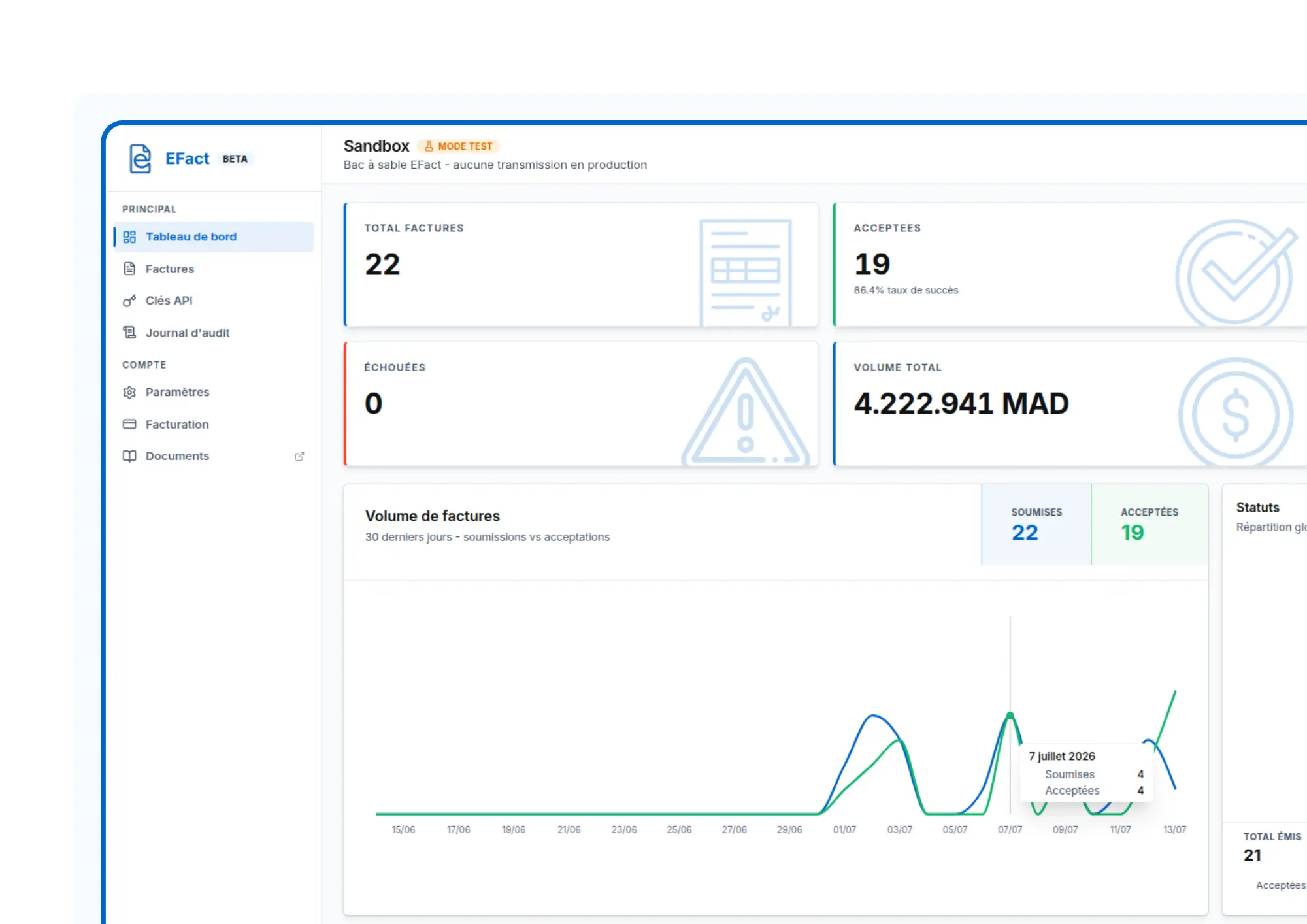
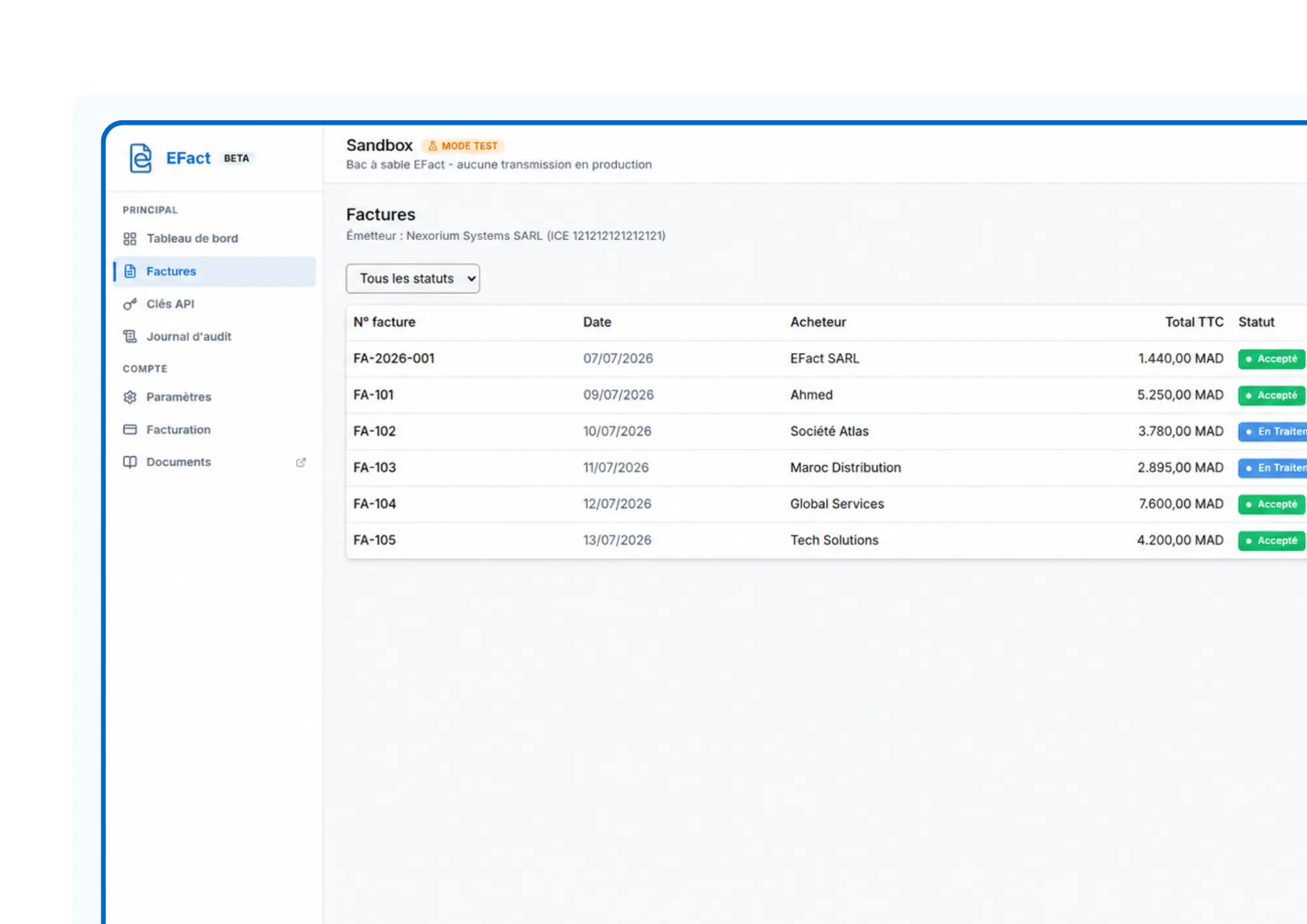
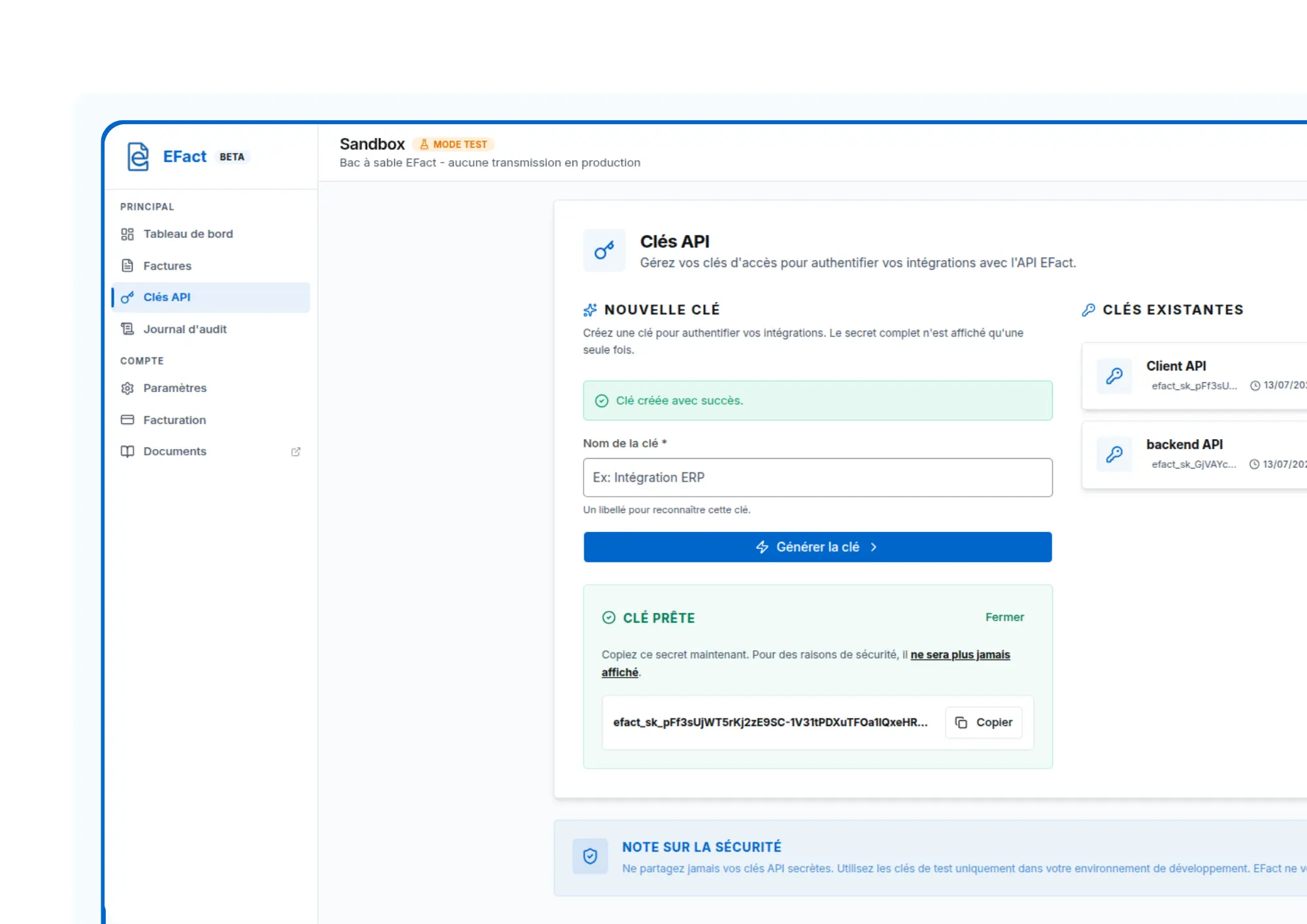
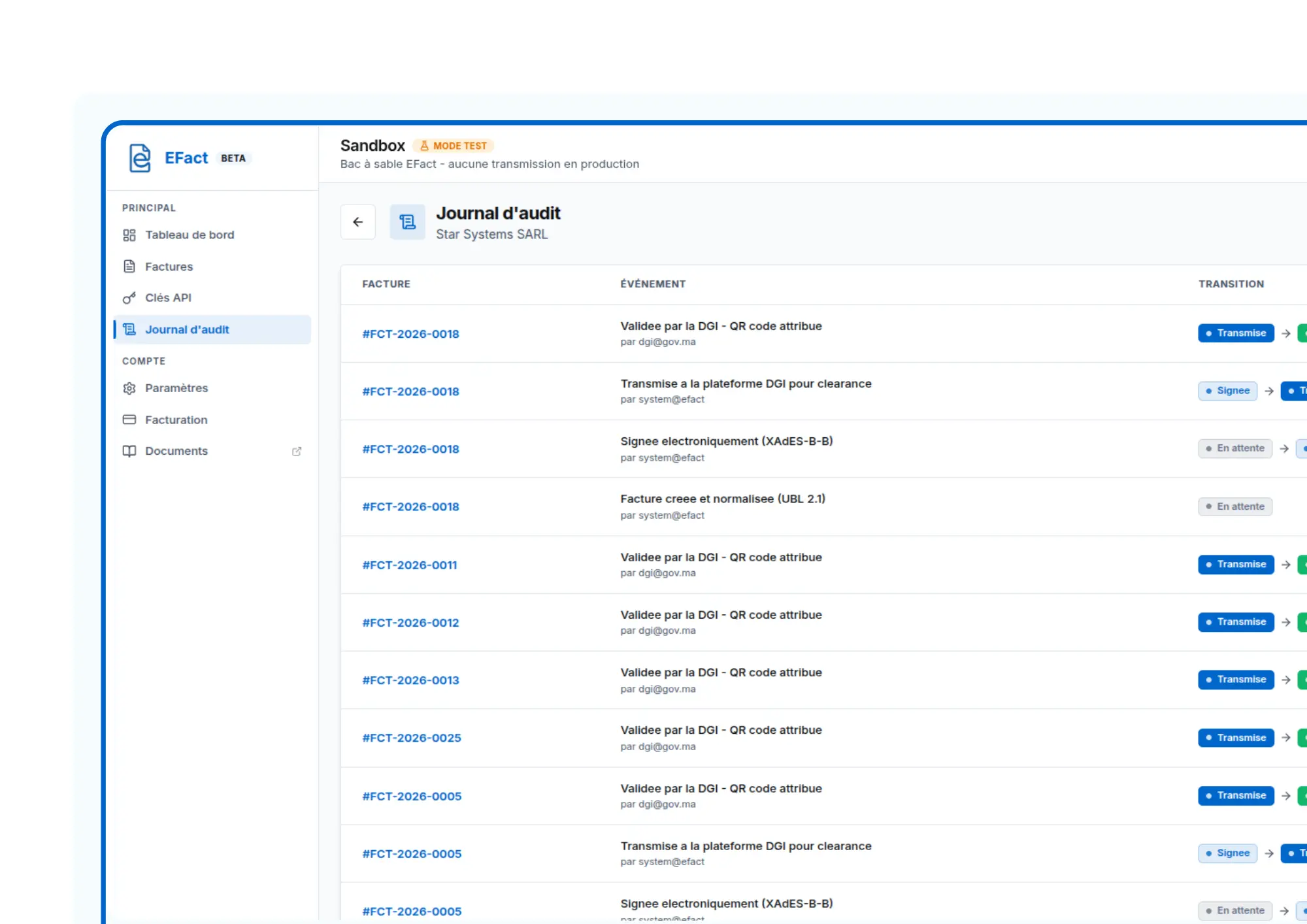
Total control with the management dashboard
A single dashboard to pilot everything. Track your invoices, manage API keys, and audit every event from one unified interface.
Integrate EFact into your stack.
The Node.js SDK is available today. Python, Java, PHP, and .NET are in development.
Understand the reform before integrating.
Have questions? We have answers.
Everything you need to know about Morocco DGI 2026 e-invoicing and the EFact API. Have more questions? Contact our team.
Read the docsArticle 145-IX of Morocco's General Tax Code (CGI) makes structured electronic invoicing mandatory under a clearance model: each invoice is sent to the DGI (Direction Générale des Impôts) platform for validation before it reaches the buyer. Invoices use UBL 2.1 or CII XML. The DGI has announced a phased rollout starting with large companies; the exact calendar and thresholds depend on the implementing decree.
Full DGI 2026 compliance guide