
The 12 Technical Requirements Imposed by the DGI for E-Invoicing in Morocco in 2026
In brief. E-invoicing in Morocco is not merely about producing a PDF, nor is it just about generating an XML file. It imposes a set of cumulative technical requirements: a standardized structured format, prior DGI (Direction Générale des Impôts, Morocco's tax authority) validation (visa fiscal) through the national platform (clearance model), application of Moroccan tax rules, electronic signature, exchange and rejection management, data integrity, compliant legal archiving, security, regulatory monitoring, testing strategy, and end-to-end auditability. Each of these requirements is a full-fledged project in its own right. Taken together, they constitute a dedicated compliance infrastructure - not just another feature in an ERP.
Introduction: Why DGI Compliance Has Nothing to Do with Generating a PDF
Ever since Article 145-IX of the General Tax Code (CGI) established the mandate for electronic invoicing in Morocco, a persistent misunderstanding has taken hold in many technical departments: conflating an electronic invoice with a digitized invoice.
A PDF sent by email is a digital invoice. It is not an electronic invoice in the regulatory sense. The difference is not cosmetic; it is structural: a PDF is designed for a human reader, whereas an electronic invoice is designed for a machine - that of the tax authority, that of your customer, and that of their accounting software.
This shift fundamentally changes three things in the architecture of any invoicing software in Morocco:
- The invoice ceases to be a document and becomes a data stream. It no longer exists as a visual layout, but as a set of standardized fields, verifiable line by line.
- The invoice ceases to be a unilateral act and becomes a transaction validated by a third party. In the clearance model adopted by Morocco, an invoice acquires its legal validity only after DGI validation (visa fiscal). Your software is no longer the sole master of the document lifecycle.
- Compliance ceases to be a state and becomes a continuous process. Specifications evolve, tax rules change with every Finance Act (Loi de Finances), and electronic signature certificates expire. Being compliant in January guarantees nothing for December.
For a CTO, an ERP vendor, or a CFO, the real question is therefore not "How long does it take to generate XML?". The question is: "What infrastructure must we build, operate, secure, and continuously maintain so that no invoice issued by the company is ever rejected, invalidated, or challenged during an audit?"
This article breaks down the twelve technical requirements that every billing and accounting software must fulfill. It is not an implementation guide: it is an objective assessment of the real-world complexity, intended for decision-makers who must arbitrate between building this infrastructure in-house or integrating a specialized compliance layer.
Methodological note. As of the publication date of this article, the implementing decree for the reform has not yet been published in the Bulletin Officiel (Morocco's official gazette). The final thresholds, rollout calendar, and definitive technical specifications will be enacted by this decree and by subsequent DGI technical releases. Many online sources announce precise deployment dates that do not stem from any official publication. The requirements described below represent the structurally stable foundation of any clearance-based e-invoicing framework - what engineering teams can prepare for today without risking misplaced effort.
For the overall legal framework of the reform, see our comprehensive reference guide to mandatory e-invoicing in Morocco in 2026. For the specific challenge of integrating with an existing ERP, see how to make your ERP DGI-compliant without replacing it.
1. Using a Structured Format Compliant with DGI Requirements
The first requirement is also the most frequently misunderstood. Generating an XML file does not mean generating a compliant invoice.
Morocco is aligning with established international structured standards, foremost among them UBL 2.1 (Universal Business Language, a standard published by OASIS), which is widely used by e-invoicing systems worldwide. These formats represent the invoice as normalized data: legal identity and tax identifiers of both parties, ICE (Identifiant Commun de l'Entreprise, the 15-digit Moroccan company ID), IF (Identifiant Fiscal, tax ID), line items, VAT rates and bases, totals, currency, payment terms, and purchase order references.
The Pitfall: Syntactic Compliance Is Not Semantic Compliance
A file can be perfectly valid against the technical schema and still be rejected. This is the crucial nuance underestimated by almost every engineering team approaching the topic for the first time.
In practice, an e-invoicing framework relies on multiple layered validation tiers:
- A structural tier, which verifies that the document complies with the format syntax (presence of mandatory elements, element order, cardinality, data types);
- A business rules tier, which checks internal consistency (do the line items sum up to the subtotal? does the VAT breakdown match the declared rates? is a foreign currency accompanied by required exchange details?);
- A national tier, specific to Morocco, which applies local legal rules: format and checksum validity of the ICE, IF, applicable Moroccan VAT rates, mandatory legal notices required by Article 145-IX of the General Tax Code (CGI), and official document typologies and tax codes.
This third tier does not exist out of the box in any international ERP. An ERP built for European or American markets can produce standard XML, but it knows nothing of the Moroccan ICE checksum, the local VAT grid, or the statutory notices dictated by Article 145 of the CGI.
What This Means in Practice
Maintaining compliant invoice generation requires managing versioned rule sets, tracking regulatory updates, regression testing every modification against the full spectrum of business workflows, and handling hundreds of permutations between operation types, tax regimes, rates, exemptions, and currencies. This is not a one-off software feature - it is a living regulatory engine.
2. Adhering to the Clearance Model Imposed by the DGI
Morocco has adopted the clearance model (pre-clearance validation) - a paradigm also selected by jurisdictions such as Mexico, Turkey, Italy, and Saudi Arabia. This is a foundational architectural choice that transforms the very essence of the billing process.
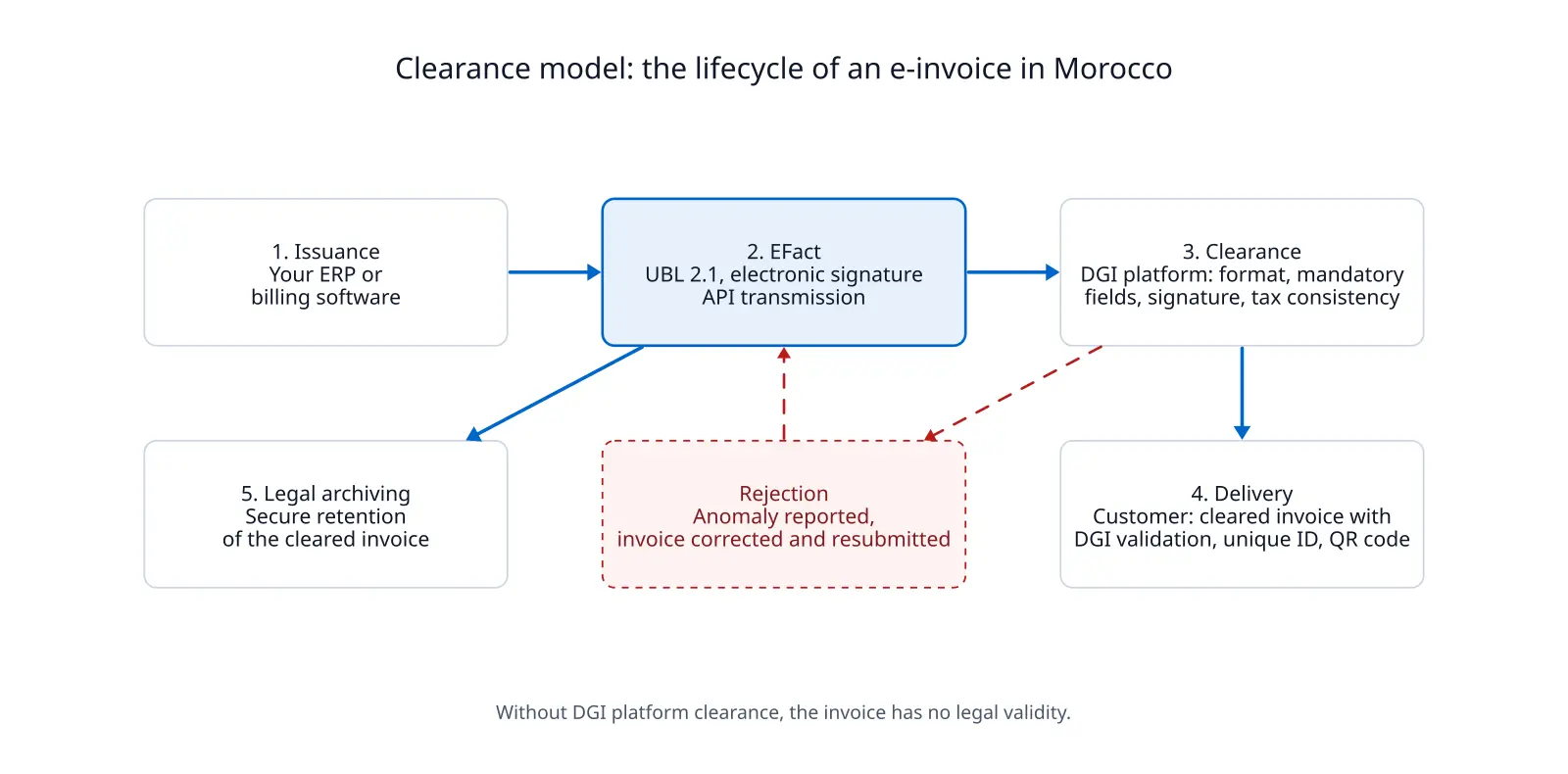
In a traditional post-audit model, a company issues its invoice, sends it directly to the customer, and reports it to the tax administration after the fact. In a clearance model, the invoice must be transmitted to the tax authority's platform before it is issued to the buyer. Only after successful DGI validation does it acquire legal validity.
The Architectural Consequences Are Profound
- Your software now relies on an external system to finalize any commercial transaction. An unvalidated invoice is legally non-existent. Platform availability becomes a critical runtime dependency for your entire revenue chain.
- The document lifecycle becomes a state machine. An invoice is no longer simply "issued" or "unissued": it moves through states such as draft, submitted, pending, validated, rejected, corrected, resubmitted, and canceled. Each state must be persisted, synchronized with general ledger accounting, and surfaced cleanly in the UI.
- Processing becomes asynchronous. System responses can be instantaneous or deferred. Your architecture must handle latency without locking sales workflows, prevent duplicate submissions during retries, and guarantee idempotency so that no invoice is submitted twice with conflicting identifiers.
- Traffic spikes become a core operational risk. B2B invoicing concentrates heavily at month-end, quarter-end, and fiscal year-end. An infrastructure capable of processing 100 invoices a day may collapse under 20,000 invoices on December 31.
The Question Few Teams Ask in Time
What happens if the platform suffers downtime during your peak billing hours? Can you continue dispatching shipments, receiving payments, and closing periods? Answering this requires robust queuing, automated recovery, and dead-letter replay mechanisms - a resilient messaging architecture complete with end-to-end telemetry and operational supervision.
Looking to evaluate the gap between your current software and these clearance requirements?
The EFact Sandbox lets you submit a test invoice and observe the complete lifecycle - validation against the EFact DGI simulator, conversion, and status progression - with mock data and zero commitment.
3. Enforcing Moroccan Tax Rules
This is the requirement most commonly underestimated by technical teams, precisely because it is not purely technical. A technically flawless file that applies an incorrect tax rule remains a non-compliant invoice - and an immediate tax liability.
Moroccan indirect taxation features a dense web of specific edge cases that few generic billing tools model accurately:
- Multiple statutory VAT rates applicable depending on goods and service classifications, with frequent revisions introduced by successive Finance Acts (Lois de Finances);
- Exemptions with deductibility rights versus exemptions without deductibility rights, which require distinct data treatments and reporting flags;
- Operations under tax suspension regimes, subject to specific legal notices and supporting certificate numbers;
- The debit regime versus the cash accounting (encaissement) regime, which govern different rules for VAT chargeability;
- Withholding tax (retenue à la source) mechanisms applicable to specific supplier and transaction categories;
- Foreign currency invoicing, requiring exchange rate conversion and local currency equivalent reporting;
- Rounding rules and mathematical consistency across line bases, tax totals, and invoice grand totals - internationally recognized as the number-one cause of clearance rejection;
- Mandatory legal notices stipulated by the General Tax Code (CGI), the absence of which renders the invoice invalid regardless of data integrity.
The Real Problem: The Regulatory Framework Evolves Annually
A tax rules engine is never a finished product. Every annual Finance Act can adjust a tax bracket, introduce an exemption, or redefine taxable tax bases. Software that hard-codes these rules will inevitably drift out of compliance without anyone noticing - until an audit strikes.
For a software vendor, the consequence is immediate: embedding Moroccan tax logic into a core codebase means committing to continuous regulatory monitoring, analyzing every legal reform, updating business logic, running test suites, and deploying updates across the entire client install base before statutory deadlines. For an engineering team without an in-house Moroccan tax specialist, this represents substantial operational exposure.
4. Implementing a Qualified Electronic Signature
An electronic signature guarantees two inseparable legal properties: authenticity of origin (verifying that the invoice originates from the stated issuer) and integrity of content (ensuring any subsequent alteration is immediately detectable). It attaches to the structured XML payload, not to a visual PDF rendering.
The Moroccan regulatory framework governing trust services for electronic transactions sets strict standards for digital signatures, establishing distinct certificate tiers and accredited trust service providers. Technically, signing an electronic invoice is entirely different from pasting a PNG signature onto a PDF: it is applied cryptography using standardized signature profiles (such as XAdES) and long-term validation evidence.
The Real Cost Lies in the Lifecycle, Not the Signing Function
Many development teams budget for the initial signing algorithm while overlooking ongoing operations. The true friction points lie in certificate lifecycle management:
- Procurement and renewal of digital certificates from accredited trust service providers, subject to administrative lead times beyond your control;
- Private key protection, which cannot be treated like ordinary application environment variables - key compromise exposes the organization to massive liability across all issued invoices;
- Certificate expiration management: what happens to invoices signed with a certificate that has since expired or been revoked? How do you prove five years later that the signature was valid at the precise moment of issuance?
- Qualified timestamping and archiving of validation materials (OCSP responses, CRLs), essential for maintaining non-repudiation throughout the mandatory statutory retention period;
- Multi-tenant operations: a conglomerate with multiple subsidiaries, or a B2B SaaS platform serving hundreds of tenants, must manage as many distinct certificates, credentials, and renewal cycles.
This is an ongoing operational duty, not a static software module. None of these operational constraints are apparent in a simple proof of concept; all of them surface in production.
5. Managing Communication with the National Platform
Once an invoice is correctly formatted, tax-validated, and signed, it must be transmitted to the national platform reliably, securely, and resiliently.
This communication requires implementing a suite of connectivity mechanisms that may seem trivial in isolation, but collectively represent the bulk of operational overhead:
- Authentication with the national platform and credentials lifecycle management;
- Rate limiting and quota management, including adaptive throttling and backoff algorithms to prevent service denial;
- Status retrieval and polling, where technical response codes must be translated into actionable operational insights for non-technical users;
- Error taxonomy handling: distinguishing transient errors (network timeouts, service throttling - candidates for retry) from permanent rejections (business rule violations, invalid tax IDs - requiring user correction), and never conflating the two, as automated retries on permanent rejections flood queues and cause incident cascades;
- Continuous reconciliation between what your ERP records as sent and what the national platform has actually cleared and registered;
- Environment segregation between sandbox testing and live production environments, maintaining distinct datasets and configurations.
The Hidden Cost: Continuous Observability
Integration with a national gateway is never a set-and-forget task. It demands continuous monitoring: proactive alerting during service degradation, throughput metrics, stuck invoice detection, and documented escalation runbooks. Without proactive observability, an organization can discover at month-end closing that hundreds of invoices were never cleared - and therefore never legally existed.
6. Managing Rejections and Electronic Credit Notes
Under a clearance model, rejection is not an unforeseen exception: it is a normal system state that must be fully industrialized.
Handling Rejections
An invoice may be rejected for dozens of reasons: invalid customer ICE or IF, rounding discrepancy, invalid VAT rate, missing mandatory legal notice, missing purchase order reference, or duplicated invoice number. Every rejection triggers a chain of strict operational requirements:
- Pinpointing the root cause and translating it into plain business terms for accountants and billing specialists;
- Correcting the error at the source in the ERP or billing software, rather than patching the generated XML payload - otherwise, the divergence between internal accounting records and official tax documents widens;
- Resubmitting the corrected document without creating numbering collisions or breaking the chronological sequence;
- Maintaining an immutable audit trail of the rejection incident and resolution, as this documentation may be requested during a tax inspection;
- Above all: ensuring rapid remediation, because a rejected invoice does not legally exist - which means receivables are not enforceable and revenue cannot be recognized.
Credit Notes and Corrections
Amending an already cleared invoice is radically different from editing an internal draft. The rectifying document (credit note or corrective invoice) must explicitly reference the original cleared invoice, follow its own strict sequence, undergo its own pre-clearance validation, digital signature, and legal archiving, and reconcile with the general ledger. The boundaries between cancellation, rectification, and commercial credit notes must be rigorously modeled - any confusion here creates reconciliation discrepancies that only surface during annual tax filing.
What CFOs remember. Rejection management is not merely a technical topic: it is a core business process. Who receives the alert? Within what SLA? Who has permission to authorize changes? What happens during holiday closures? An e-invoicing architecture without an operational rejection workflow is a cash collection time bomb.
7. Guaranteeing Data Integrity
Integrity is the requirement that conflicts most directly with established habits in legacy billing and ERP software.
In many ERPs and accounting systems deployed across Moroccan businesses, an invoice remains editable: users update an amount, modify a delivery address, and reprint the document. In a compliant electronic invoicing framework, this flexibility ceases to exist. Once an invoice has been cleared and signed, it is strictly frozen: any subsequent modification breaks the digital signature and renders the document legally unenforceable.
This mandates several concrete technical safeguards:
- Immutability of the issued document, enforcing a strict decoupling between operational ERP records (which may be subject to internal notes) and the cleared tax document (which is immutable);
- Tamper detection, typically achieved through cryptographic hashes computed, recorded, and monitored over time;
- Sequential continuity and uniqueness of invoice numbering, guaranteeing zero gaps and zero duplicates, even during system crashes, retries, or concurrent processing;
- Continuous synchronization between internal accounting entries and the document cleared by the tax administration - any discrepancy between the two is treated as a red flag during a tax audit;
- Granular write-access governance, ensuring that no user role, including system administrators, can modify or delete cleared invoices without triggering an immutable audit trail.
For software vendors, this often requires overhauling a data model designed a decade or more ago around architectural assumptions that are now legally obsolete. This is not an incremental update - it is a fundamental refactoring of core software logic.
8. Ensuring Compliant Legal Archiving
Moroccan commercial law (notably Law No. 9-88 on accounting obligations) already mandates retaining accounting records for ten years. Electronic invoicing fundamentally shifts the scope: it is no longer the paper printout or simple PDF that must be stored, but the original signed structured document alongside all cryptographic and clearance artifacts required to prove its legal validity.
Compliant legal archiving requires far more than passive cloud storage or disk capacity:
- Preserving the original signed XML document, rather than a rendered or transformed representation;
- Retaining clearance proofs, validation tokens, and lifecycle metadata issued during pre-clearance;
- Guaranteeing integrity across the statutory 10-year retention period, which raises the challenge of verifying digital signatures whose underlying certificates will have expired years before an audit;
- Ensuring long-term readability: technical specifications and software tools evolve, but archived invoices must remain readable and exportable ten years down the line;
- Facilitating instant discovery and extraction: during a tax audit, the administration expects rapid, structured, and comprehensive retrieval by date range, counterparty, or transaction type;
- Ensuring high availability and multi-region disaster recovery: losing the archive means losing legal proof of ten years of corporate revenue and VAT deductions.
The Classic Mistake
Many technical teams treat archiving as an afterthought, assumed to be solved by standard database backups. A backup is not compliant legal archiving: it provides neither guaranteed immutability, nor access audit trails, nor targeted extraction tools, nor long-term signature validation preservation. That distinction only becomes obvious when an auditor challenges document validity.
9. Meeting Enterprise Security and Privacy Standards
An electronic invoicing gateway consolidates an enterprise's most sensitive commercial intelligence: customer lists, transaction volumes, pricing structures, margins, and cash flow timing. It represents both a high-value target for threat actors and a single point of operational failure.
Security requirements cover, at a minimum:
- Data privacy and personal data protection, strictly regulated in Morocco by Law No. 09-08 on the protection of individuals with regard to the processing of personal data;
- Protection of cryptographic keys and signing secrets, requiring hardware security modules (HSM) or enterprise key vaults with access controls far beyond typical business software standards;
- Environment segregation and strict role-based access control (RBAC), including stringent restrictions for internal staff;
- Tamper-evident audit logging of every transaction, access request, and administrative action;
- Operational resilience: comprehensive business continuity plans (BCP), disaster recovery plans (DRP), and high-availability SLAs compatible with operations that cannot pause during peak month-end billing;
- Software supply chain security, continually scanning dependencies and packages - frequently the weakest link in custom internal builds;
- Incident response readiness, backed by rehearsed remediation playbooks and clearly defined incident response teams.
In short: the required security posture is that of critical financial infrastructure, not a casual billing add-on. Assembling the specialized talent required to operate at this level cannot be achieved in a few weeks, and the recurring payroll of an experienced security and SRE team often eclipses the initial build budget.
10. Anticipating Regulatory and Technical Evolution
This is the most financially decisive requirement, yet paradoxically the one that rarely appears in initial technical specifications.
Compliance is never a static achievement. It evolves continuously across three concurrent vectors:
- The legal vector. The implementing decree, administrative circulars, and successive annual Finance Acts introduce adjustments to deployment timelines, business scopes, reporting requirements, and non-compliance penalties.
- The fiscal vector. VAT rates, statutory exemptions, tax bases, and special regimes are adjusted regularly, each change rippling directly into document creation and calculation logic.
- The technical vector. Clearance specifications are versioned APIs. Global experience from jurisdictions that rolled out clearance frameworks demonstrates that early years are marked by frequent schema updates: newly introduced validation rules, revised code lists, mandatory extra fields, and protocol updates.
What This Means for Engineering Budgets
An in-house compliance project has no finish date. It generates recurring operational overhead: ongoing legal and tax monitoring, technical protocol tracking, impact assessments, development, regression testing across diverse business scenarios, and coordinated deployments - all executed against strict statutory deadlines beyond your control.
For software vendors and ISVs, the operational multiplier is brutal: each regulatory update must be implemented, tested, and deployed not once, but across every active customer environment and legacy version. This is precisely how a compliance engine built "once and for all" turns into the single most expensive maintenance sinkhole on the product roadmap within two years.
Are you a software vendor, ERP provider, or systems integrator?
Instead of absorbing every regulatory shift into your core product roadmap, delegate compliance to a shared, specialized layer. Check out the EFact API documentation and run your first test requests in the Sandbox.
11. Establishing a Robust Testing and Validation Strategy
In a domain where a software defect results not in a simple UI glitch but in a tax infraction, testing ceases to be merely a software engineering best practice - it becomes an absolute compliance mandate.
A comprehensive testing strategy must span several distinct dimensions:
- Compliance testing. Validating that generated documents satisfy all validation layers across a rich dataset mirroring true operational diversity - not just three happy-path sample invoices.
- Edge case testing. Foreign currencies, cascading multi-level discounts, statutory exemptions, mixed operations, invoices with thousands of line items, partial credit notes, cross-border clients, and unfavorable rounding edge cases. These scenarios, though low in transaction volume, account for the vast majority of real-world clearance rejections.
- Automated regression testing. With every regulatory revision, teams must verify that historical billing scenarios continue to clear without regression. Without an automated test harness, maintaining compliance within mandated transition windows becomes impossible.
- Load and stress testing. Benchmarking system performance against month-end and year-end traffic spikes, including testing resilience under degraded external gateway conditions.
- Parallel run (dual running). Running legacy and clearance flows concurrently throughout a trial phase, comparing accounting reconciliation outputs, and executing cutover only once data consistency is fully proven.
- Master data sanitization. Auditing customer master records before launch: missing ICE or IF identifiers, incomplete addresses, and duplicate entity records. International experience shows that most initial clearance rejections stem from dirty master data, not code defects.
Building and maintaining this automated testing harness typically requires an engineering investment equal to or greater than the development of the invoicing logic itself.
12. Guaranteeing End-to-End Operational Traceability
The final technical requirement is the very first one demanded during a tax inspection: the capability to conclusively prove every step of the transaction.
The required traceability extends far beyond standard application log files. It must reconstruct an unbroken, tamper-evident audit trail for any invoice at any historical point in time:
- Who created the invoice, at what exact timestamp, from which source data;
- Which validation rules were evaluated and their individual outcomes;
- When the document was digitally signed, using which certificate, and via which cryptographic mechanism;
- When it was transmitted to the national platform, what clearance response was received, and under which registration identifier;
- Which corrective documents or credit notes are linked to it, along with the business rationale;
- Who accessed, exported, or retrieved the archived file.
This audit trail must be correlated end to end - linking the general ledger journal entry, the cleared legal document, and the low-level API exchange so that any transaction can be reconstructed without forensic investigation. Furthermore, this audit trail must be retained for the same duration as the invoices themselves (ten years under Moroccan commercial law), creating storage and indexing challenges that are rarely budgeted in advance.
Inadequate traceability never causes issues during routine daily operations. It reveals itself only once, at the worst possible moment: when defending transactions before tax inspectors and finding that the technical proof is missing.
Is Your Software Ready for 2026?
The twelve technical requirements detailed above apply to any system that generates invoices - not just enterprise ERPs. Below is a self-assessment matrix categorized by software type.
Overview
| Software Category | Most Common Failure Point | In-House Compliance Effort |
|---|---|---|
| ERP (Odoo, SAP, Sage, Dynamics, ERPNext) | Lack of Moroccan tax rules engine and national platform gateway | High |
| Accounting software | Post-issuance invoice editing, unguaranteed sequential integrity | High |
| POS / Point of Sale software | Transaction volume, offline degradation mode, real-time lifecycle | Very high |
| Vertical SaaS application | Multi-tenancy, per-tenant certificate management, data isolation | Very high |
| Custom in-house billing software | Absence of structured regulatory and technical monitoring | High and recurring |
Checklist - ERP
- Do invoices exist as normalized, machine-readable structured data independent of layout and presentation?
- Are customer tax identifiers (ICE, IF) strictly validated at data entry rather than simply stored as free text?
- Is VAT breakdown modeled line by line, including support for statutory exemptions and special regimes?
- Can the system track external lifecycle states (pending, cleared, rejected) on every invoice?
- Is there a single technical hook or event where an invoice is finalized and locked?
- Will existing custom modules survive standard vendor version upgrades?
Checklist - Accounting Software
- Can an issued invoice still be edited or deleted by an end user or administrator?
- Are sequential numbering series strictly guaranteed against gaps and duplicates, even during system crashes?
- Are credit notes and adjustments linked to the original cleared document via unambiguous data references?
- Can general ledger entries be automatically reconciled with issued clearance records?
- Does archiving retain the original signed structured XML or merely a printable representation?
Checklist - POS and Retail Systems
- Can checkout operations continue in an offline degraded mode if external clearance gateways experience downtime, without blocking retail lanes?
- Is high ticket throughput compatible with granular transaction-level clearance and status tracking?
- Do distributed retail terminals possess adequate connectivity and health monitoring?
- Does disaster recovery guarantee that no receipt is lost or submitted twice?
- Can regulatory schema updates be pushed rapidly across an entire distributed POS estate?
Checklist - B2B SaaS Applications
- Does the multi-tenant architecture support managing discrete signing certificates and keys per tenant?
- Is tenant data segregated at a security tier compliant with enterprise and privacy standards?
- Can regulatory updates be deployed centrally without manual intervention for each tenant?
- Are external gateway rate limits and quotas throttled fairly across all active tenants?
- Does your own SaaS subscription billing rely on the same pipeline - and therefore carry the same operational risk?
Checklist - Custom In-House Software
- Who within the company actively conducts continuous legal, tax, and technical monitoring for e-invoicing?
- What happens to compliance continuity if the lead developer who designed the compliance integration leaves?
- Is there an automated regression test suite that can certify a regulatory schema change within days?
- Has the recurring annual maintenance cost of this integration been budgeted, or only the initial build?
- Is the organization prepared to assume sole legal liability for a technical non-compliance failure?
Simple rule of thumb. If you answer "no" or "I don't know" to more than two questions in any given checklist, bringing your system into compliance is not a matter of a few weeks. It is a full-scale corporate initiative with an allocated budget, dedicated engineering resources, and direct legal liability.
Build vs. Buy: The Case for a Compliance Layer
At this stage, the decision becomes straightforward. It is not a matter of whether your internal engineering team is capable of building it - they almost certainly are. It is a matter of whether doing so represents a rational allocation of engineering capital given the legal exposure, ongoing maintenance overhead, and implementation timeline.
Structural Comparison
| Evaluation Criterion | In-House Development | EFact Compliance Layer |
|---|---|---|
| Development costs | Twelve separate workstreams: data formatting, tax engine, digital signature, platform exchanges, rejection workflows, data integrity, legal archiving, security, testing harness, traceability, monitoring, regulatory tracking | A single API integration connected at the invoice validation hook |
| Maintenance costs | Ongoing and compounding: every regulatory update requires a complete cycle of analysis, development, regression testing, and deployment | Predictable subscription; regulatory updates absorbed transparently on the platform side |
| Legal risk | Borne entirely by your organization: rejected invoices, disputed VAT deductibility, financial penalties, commercial disputes | Mitigated via a battle-tested, shared pipeline audited across all enterprise tenants |
| Technical complexity | Standardized XML, applied cryptography, Moroccan tax rules, resilient asynchronous messaging, compliant legal archiving | A clean API call and a status webhook |
| Time to market | Several months, with no guarantee of clearance compliance on the first attempt | A few days to a few weeks of integration |
| Scalability | Must be sized, tested, and provisioned for peak period-end traffic surges | Shared enterprise-grade scalability, proven on aggregated transaction volumes |
| Regulatory monitoring | Must be built from scratch: continuous legal, fiscal, and technical watch | Included in the managed service with zero engineering overhead for your team |
| Required skillset | Software engineers, cryptography specialist, tax legal counsel, DevOps/SRE, security officer | One software developer and developer documentation |
| Economies of scale (ISVs) | Every customer tenant to maintain, every deployed version to patch | A single compliance endpoint across your entire product portfolio |
The Financial Equation Evaluated by Engineering Leadership
The conventional analysis simply compares initial development headcount costs against SaaS subscription fees. That calculation is fundamentally incomplete, as it ignores three decisive financial drivers:
- The cost of continuous maintenance. Initial development is a one-time project; regulatory maintenance is an indefinite commitment. Over a 3-to-5-year horizon, ongoing maintenance dominates the total cost of ownership (TCO).
- The cost of non-compliance risk. A non-compliant invoice is not merely a technical glitch: it jeopardizes the buyer's VAT deductibility, damages customer relationships, and exposes the company to statutory tax penalties. This risk is hard to predict on a spreadsheet, but carries severe real-world financial consequences.
- The opportunity cost. Every engineering sprint spent by your senior architects on Moroccan VAT logic and XAdES digital signature packaging is a sprint diverted from your core product roadmap. For a software vendor, regulatory compliance is never a market differentiator - it is a baseline prerequisite. No software vendor ever won an enterprise deal because its XML serialization was elegant.
The Question for Executive Leadership
"Do we want our engineering organization to become a specialized provider of Moroccan fiscal compliance, or do we want to remain focused on our core product value while staying fully compliant?"
For virtually every ERP vendor, ISV, systems integrator, and enterprise IT department, the second option is the only strategic choice. That is precisely the purpose of a compliance layer: your existing software remains the system of record for business workflows and accounting; the entire regulatory surface - structured format, tax validation, electronic signature, platform exchanges, status lifecycle, legal archiving, and continuous regulatory adaptation - is offloaded to a specialized service.
Move from evaluation to execution.
Create a free EFact Sandbox account to submit your first test invoice in minutes, explore the API documentation, or compare our pricing plans against the true total cost of ownership of an in-house build.
Frequently Asked Questions
What are the DGI technical requirements for electronic invoicing in Morocco?
They encompass twelve core areas: standardized structured formatting (UBL 2.1), compliance with the clearance model, enforcement of Moroccan tax rules, qualified electronic signatures, communication with the national platform, rejection and credit note management, data integrity, compliant legal archiving, enterprise security, regulatory and technical monitoring, testing and validation strategy, and end-to-end auditability. These requirements are cumulative: fulfilling eleven out of twelve still leaves the organization non-compliant.
Is a digitally signed PDF sufficient for compliance?
No. A PDF, even when digitally signed, is an unstructured visual file format: it cannot be parsed, validated, or cleared automatically by tax authority platforms. Regulatory compliance mandates a structured XML document (such as UBL 2.1) that is validated, digitally signed, and cleared. A PDF may only accompany the transaction as a human-readable visual courtesy for the customer.
What is the clearance model and why does it change everything?
The clearance model requires pre-clearance validation of an invoice by the tax administration's platform before it is transmitted to the customer. An invoice acquires legal validity only after this validation. As a result, your billing software no longer controls the document lifecycle in isolation, but depends on an external platform to complete commercial transactions.
Is the UBL 2.1 format mandatory in Morocco?
Standardized structured formats, led by UBL 2.1, constitute the established foundation for clearance-based e-invoicing systems worldwide. The precise technical profiles and supported formats will be codified by technical releases from the DGI and the implementing decree. What is established is that proprietary formats and standalone PDFs are excluded.
Why can a technically valid invoice still be rejected?
Because structural validity is only the first hurdle. A document can strictly follow schema syntax yet fail on business rules (sum of lines mismatching totals, faulty VAT calculations) or national tax rules (invalid ICE or IF, missing statutory legal notices, inapplicable VAT rate). These three validation tiers operate independently.
How long does it take to build an in-house e-invoicing compliance pipeline?
Real-world implementations across similar clearance systems show that building an initial functional pipeline takes several months - and the project never truly ends, as ongoing legal, fiscal, and technical updates must be continuously absorbed. In contrast, integrating via a specialized compliance API takes days to weeks.
What happens if the validation platform experiences downtime?
This scenario must be addressed by design. It requires a resilient architecture featuring queuing, retries, dead-letter recovery, and idempotency guarantees to prevent invoice duplication, paired with real-time observability to catch stalled invoices before month-end. Without these protections, a few hours of downtime at month-end can result in hundreds of legally non-existent invoices.
Do we need to manage electronic signature certificates ourselves?
You can, but doing so requires continuous operational overhead: procuring certificates from accredited trust service providers, securing private keys in hardware or key vaults, managing renewals and revocations, and preserving validation proofs for the 10-year statutory retention period. For multi-entity groups or SaaS providers, this burden multiplies across every tenant.
How long must electronic invoices be retained under Moroccan law?
Moroccan commercial law mandates a ten-year retention period. The technical challenge lies not in the duration, but in the format: you must preserve the original signed structured XML document along with its clearance validation proofs, ensuring long-term integrity, legibility, and rapid retrieval throughout the decade.
Our ERP vendor claims they will provide compliance. Is that enough?
Ask three specific questions: by what exact delivery date, covering which of the twelve technical requirements, and how future regulatory updates will be handled (included patches, paid add-on modules, or major version upgrades)? A vague answer to any of these points indicates that the compliance risk remains on your shoulders. Our guide on making your ERP DGI-compliant outlines the key questions to ask your software vendor.
Does a compliance layer replace our ERP?
No, it complements it. Your ERP remains the central system of record for commercial operations, inventory, and accounting; the compliance layer handles regulatory transformation, signing, clearance exchanges, and archiving at the point of issuance. Daily operational workflows for your staff remain unchanged.
Where should we start if the implementing decree has not yet been published?
Start with the decree-agnostic foundational prerequisites: audit and clean customer master records (ICE, IF, addresses), map all internal invoicing systems and billing flows, identify the single technical hook where invoices are definitively validated, and test an integration in an API sandbox. This preparatory work cuts weeks off your implementation timeline once the final decree is published.
Sources and reference texts: Moroccan General Tax Code (CGI), Article 145-IX; Direction Générale des Impôts (tax.gov.ma); Moroccan legislation governing trust services for electronic transactions; Law No. 9-88 on accounting obligations of commercial entities; Law No. 09-08 on personal data protection; OASIS UBL 2.1 specification (docs.oasis-open.org). The implementing decree had not yet been published in the Bulletin Officiel as of the date of writing: final thresholds, rollout schedules, and technical specifications remain subject to its official publication. Updated July 27, 2026.
Related topics
Morocco ERP E-Invoicing: Making Your ERP DGI-Compliant
Make your ERP (Odoo, SAP, Sage, Dynamics) DGI-compliant for Morocco e-invoicing without replacing it: REST API, UBL 2.1, and signature. Free sandbox.
E-Invoicing in Morocco in 2026: The Definitive Guide to DGI Compliance with EFact
Complete guide to mandatory e-invoicing in Morocco (Article 145-IX CGI): clearance model, DGI timeline, UBL 2.1, and compliance with EFact. Free sandbox.